Part 4 of the Children and Young People (Safety and Support) Act 2025 (CYPSS Act) is an entirely new part of the legislation.
It prioritises Aboriginal and Torres Strait Islander led decision making, to address the over-representation of Aboriginal and Torres Strait Islander children and young people in the child protection and family support system.
Aboriginal and Torres Strait Islander children and young people are best supported when decisions about their lives are led by Aboriginal and Torres Strait Islander people, consistent with principles of self-determination and cultural safety.
For the first time in South Australia’s child protection law, parliament formally recognises:
- the ongoing impacts of past child removal policies, including the Stolen Generations, and
- the United Nations Declaration on the Rights of Indigenous Peoples.
The CYPSS Act recognises the strength and culture of Aboriginal and Torres Strait Islander people and includes specific provisions relating to identification, decision making, reunification, case planning and court processes.
Aboriginal and Torres Strait Islander Child Placement Principle
The CYPSS Act recognises that the best interests of Aboriginal and Torres Strait Islander children, young people, and their families are realised when the Aboriginal and Torres Strait Islander Child Placement Principle is implemented to the standard of active efforts, for each of the five elements.
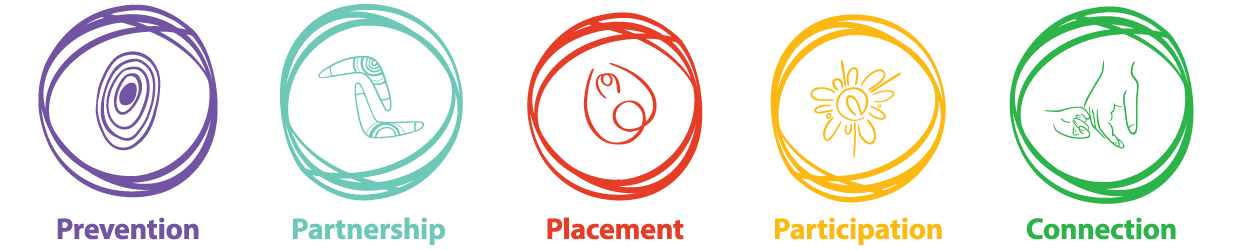
A number of additional considerations relating to reunification apply for Aboriginal and Torres Strait Islander families. These includes making active efforts to explore ways to reunify children with their parents, or place children within their own family or community.
The CYPSS Act strengthens the importance of maintaining meaningful connections for children and young people in care. The Act places a greater emphasis on preserving and supporting relationships with parents, family and kin, siblings, and community, as well as connections to Country, culture and identity for Aboriginal and Torres Strait Islander children and young people.
Under the Act, contact is recognised as an important part of a child or young person's wellbeing, identity, sense of belonging and, where appropriate, reunification with their family. Decisions about contact arrangements must be made in line with the Act's guiding principles, including the safety principle, best interests principle, principle of active efforts and principle of effective intervention.
The Act also strengthens the participation of children and young people in decisions that affect them. Contact arrangements should reflect the views and wishes of the child or young person, while ensuring their safety and wellbeing remain central considerations. These changes support greater transparency and accountability in decision-making and uphold the importance of considering and responding to each child's relationships, cultural identity and connections when developing and reviewing contact arrangements.
Section 51 legislates the principle of family-led decision making, ensuring decisions are made in culturally safe and respectful ways.
This enables culturally based, family-driven decisions making which promotes self-determination and ensures families are supported to make informed choices in the best interests of their children.
Expanding best interest considerations for Aboriginal and Torres Strait Islander children and young people:
- requires compliance with the Aboriginal and Torres Strait Islander Child Placement Principle
- acknowledges different child rearing practices
- emphasises the need for strong cultural identity and connection
- reinforces the need for safety and support to build and express cultural, spiritual and other belief systems
- ensuring children and young people have an environment in which they are supported by a carer who respects their cultural identity and nurtures their sense of self and identity in respect to their family, community, culture and Country.
The CYPSS Act supports Aboriginal‑led and community‑controlled approaches. It includes provisions that:
- allow some child protection functions to be delegated to recognised Aboriginal entities
- require a State Strategy for the Safety and Support of Children and Young People, with specific focus on Aboriginal and Torres Strait Islander children and young people
- allows for a Respected Person scheme and cultural support in some court proceedings and meetings.
The CYPSS Act legislates for family‑led decision making, recognising Aboriginal and Torres Strait Islander families have the strongest knowledge of their culture, strengths and needs.
Family group conferencing will be expanded to ensure every Aboriginal and Torres Strait Islander family has the chance to participate. This supports the involvement of family, kinship and community in keeping families together safely.
The CYPSS Act includes stronger measures to support culturally informed decision‑making. These measures include:
- making sure that every element of the Aboriginal and Torres Strait Islander Child Placement Principle has been applied to the standard of active efforts
- requiring decision makers to show that these principles have been considered in Court
- requiring Aboriginal and Torres Strait Islander people to be involved in panels and decision-making processes in relation to annual review, family group conferencing, and the Contact Arrangements Review Panel for Aboriginal and Torres Strait Islander children and young people.
Every child and young person in care must have a case plan that is purposeful, transparent, culturally safe and have an outcome-oriented plan of action. All case plans must now set out plans for reunification where viable, disability support if relevant and leaving care.
For Aboriginal and Torres Strait Islander children and young peoplecase plans must also:
- show how the Aboriginal and Torres Strait Islander Child Placement Principle has been applied
- include a cultural maintenance plan developed with the child or young person, family and community
- support connections to family, community, culture and Country.